
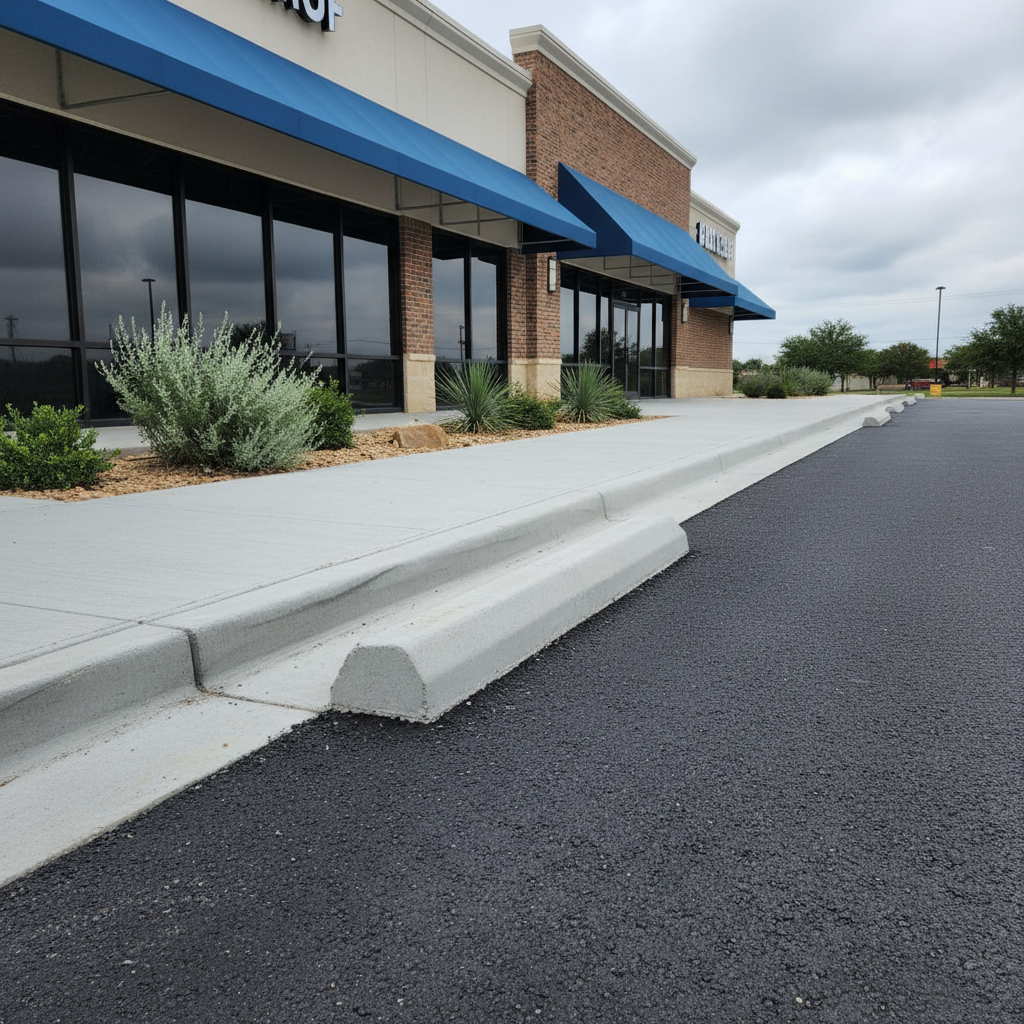
Concrete looks simple once it's cured. Grey, flat, done. What you can't see is the base underneath it, the steel inside it, and whether it was poured on a day that gave it a fair chance to set up right. Most of the mistakes that cost homeowners money in this city happen before the truck ever shows up, and most of them are invisible until a year or two later when the slab starts telling on the contractor.
Here's what actually separates a contractor worth hiring from one you'll be calling back to fix his own work.
The dirt under your driveway decides more than the contractor does
Dallas sits on Blackland Prairie clay, with Eagle Ford and Austin Chalk closer to the surface in parts of the county. That clay is expansive. It swells when it's wet and shrinks when it dries out, and between a wet spring and a dry August it can move a couple of inches. Concrete doesn't flex. If the base under it isn't compacted properly, the slab rides that movement and cracks along the weak points, usually right where nobody wants a crack: across a driveway, through a patio corner, under a porch step.
A contractor who knows the ground here will over-excavate soft or organic fill, compact a flex base of 4 to 6 inches, and in some spots recommend a sub-base of select fill if the native clay is too active. That step doesn't show up in a finished photo. It's the difference between a patio that's flat in ten years and one that's heaved at the seams by year three. Ask what they're doing under the slab before you ask what finish they're putting on top of it.
What a real bid actually specifies
A vague bid is the first sign of a vague job. A proper one should spell out:
- Slab thickness. 4 inches is standard for a driveway or patio, sometimes 5 inches where trucks or heavy vehicles will sit.
- Concrete strength, usually 3,000 to 3,500 PSI for residential flatwork in this area.
- Reinforcement. Rebar on 18 to 24 inch centers holds up better than wire mesh, which tends to sink to the bottom of the pour if nobody's chairing it up properly during placement.
- Control joint spacing. Joints should be cut roughly every 8 to 10 feet, and within 6 to 12 hours of the pour on a hot day, because the slab is going to crack somewhere and the joint tells it where.
- Cure time. Expect to stay off a new driveway for about 7 days and off a full foundation pour for closer to 28 days before it's at full strength, even though it'll look finished long before that.
If a bid just says "concrete driveway, 4 inch, $X" with no mention of base prep, reinforcement, or jointing, that's a bid you negotiate down, not one you sign.
Permits, inspections, and why skipping them bites you later
Inside Dallas city limits, a new driveway, slab foundation, or any work that alters the curb cut or right-of-way generally needs a permit, and a foundation pour gets a rebar inspection before the concrete goes down, not after. Surrounding cities each run their own process. Plano, Frisco, Richardson, Garland, and Arlington all issue separately, and a contractor who works across the metro should already know which office to call and roughly what that city checks for. If you're in a newer subdivision, there's a good chance an HOA has its own approval step on top of the city's, especially for anything visible from the street like a driveway or a decorative patio.
A contractor who tells you "we don't bother with permits on small jobs" isn't saving you money. He's leaving you holding an unpermitted slab if you ever sell the house and a buyer's inspector asks for the paperwork. On a foundation job, skipping the rebar inspection is worse, because once it's poured, nobody can verify the steel is actually in there the way it was supposed to be.
The red flags that should make you walk away
Some of these are obvious once you know to look for them, but plenty of homeowners don't find out until the slab's already poured.
A price that's dramatically lower than every other bid usually means thinner concrete, no rebar, or a crew that's going to skip the base compaction and hope the clay cooperates. It often won't.
No physical address, no local references, and a crew that showed up in an unmarked truck. Concrete work is heavy, and it's common for a contractor to sub out the flatwork crew. That's not automatically a problem, but you want to know who's actually on your property and that they're covered.
Pressure to pour the same week, especially in July or August, without any mention of how they're going to manage the heat. That's a corner-cutting tell, not a sign of efficiency.
A verbal agreement with nothing in writing about thickness, PSI, reinforcement, or jointing. If it's not on paper, it's not what you're getting.
Timing the pour around Dallas weather
Summer here means stretches of 100-degree days from June through August, and concrete poured in that heat can lose surface moisture faster than it can cure, which shows up later as crazing or plastic shrinkage cracks. A contractor working in summer should be pouring early morning, misting the surface, and getting a curing compound down fast, not pouring at noon and walking away.
Spring brings the heaviest rain, usually April and May, and a fresh pour caught in a downpour before it's set can wash out the surface or leave it pitted. A contractor watching the forecast will push a pour back a day rather than fight the rain.
Winter here is mild most years, but Dallas does get nights below freezing from December into February, and concrete that freezes before it's cured enough loses strength permanently. A contractor who's done this a while will check the overnight lows before committing to a late-fall or winter pour date, not just the daytime forecast.
None of this is complicated once you know what to ask. A contractor who answers these questions without hesitating has probably poured a hundred driveways in this clay and knows exactly what it does. One who gets vague or annoyed by the questions is telling you something too. If you want a second opinion on a bid or a quote on any of this flatwork, foundation, or repair work, Bedrock Concrete Construction is happy to walk the site with you before anything gets poured.